A work in progress
Art, just like science, is not my strong suit. But we manage with a lot of support from outside sources. My favouirte support is Painting at School by Dick Bruin and Attie Lichthart.
Grade nine art lessons are punctuated with lots of work with black and white, light and dark, and seeing all the shades of grey that come in between. It’s about a lack of sharp lines and a blending of edges into empty space.
It’s the grade nine student’s first steps into a world of seeing what’s really there and understanding that there are so many layers to what at first seems black and white.
It’s about so much more than art.
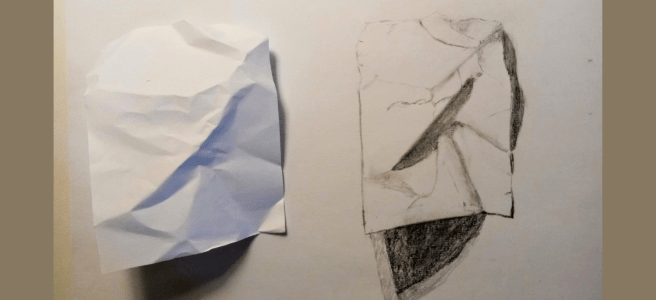
The image above is an in-progress first attempt at drawing a crumpled piece of paper. We started simply, with just a slightly crumpled sheet, and will work our way to a sheet crumpled into a ball. It’s an activity that takes time, but at the same time, must be done in one shot, because you’ll never get the light and position the same again.
This experience, and the many the will come after this which look at light and shadow and grey, speak deeply to the 14 and 15 year old. These exercises require the child to adhere to the “rules” of light and shadow and really tap into their power of observation. The longer they look at the object to be drawn, the more detail they will see in the gradient of greys. This is a lesson of polarities and contrasts. Often, the beginning of this phase of childhood is marked by a fixed way of looking at the world. These experiences support the child’s blossoming ability for abstract, analytical thought with the need to pay attention to detail. It is the first stone on a path to shedding their black and white thinking for the ability and willingness to see the subtleties of human life and experience.
It’s a challenge. And it’s exactly what is needed at this age.
Until next time
Marina
Discover more from Growing Together in Freedom
Subscribe to get the latest posts sent to your email.

