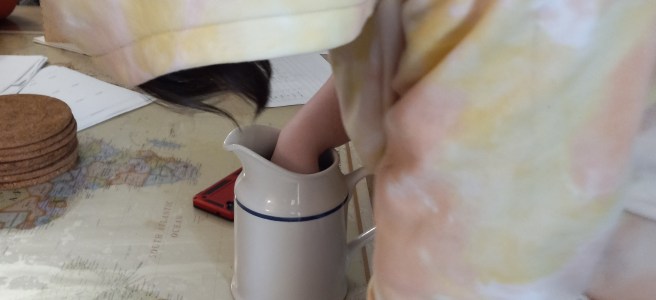
Have you ever stuck your hand in a pitcher full of ice water?
What did it feel like? How long did you last? Did you try it again? What were the sensations the second time around? Did you last longer? Did you use any coping mechanisms?
These are all discussions that came up when we did this experiment in our last science block, Intro to Neuroscience. They were learning about pain receptors and one of the experiments was to hold their hand in ice water. But it is important to point out the questions above were not questions asked by me. In fact, I asked no questions at all during the entire experiment! The questions I asked you were from the experiences my children related to me during and after the experiment.
One of the MANY things I love about a Steiner inspired education is the way science is approached.
It is not simply a matter of teaching a concept and then having the children recreate the concept on their own.
Steiner inspired science education is created around children coming to their own conclusions through hands-on, interactive experiences where through time, and sometimes with some support from the teacher, they discover the phenomenon through their own tinkering with the experiment. It is only AFTER they have really experienced the phenomenon that specific concepts are brought to them.
When science is hands on and focuses on children experiencing the phenomenon (aka phenomenological science, say that five times fast!), adults don’t need to ask questions because the children openly discuss what is being experienced. From there, they are led, through their own trial, error and thoughts, to the laws, or science, behind the phenomenon.
Here is a quote from Michael D’Aleo, from his article “What is Phenomenology”
In a phenomenological approach, one strives to give the students an experience of the phenomena and then have them wrestle with finding relationships or order. This process actually cultivates the true powers and capacities necessary for thinking. Here thinking becomes an activity, a verb, something that is dynamic and living. In a more conventional approach, the laws or relationships are initially given and then the student is guided through a proof of why they hold true. In this second approach, the students do not need to utilize their own thinking capacities in the same manner since they simply need to follow a logical argument rather than having an insight themselves as required in the phenomenological approach. In this second case, the thinking becomes a process of data acquisition and accessing.
What is interesting about these two approaches is that in fact, almost every new idea and invention that has arisen in science has resulted from a person consciously or unconsciously using a phenomenological approach. Often this can unconsciously result when a scientist is working with an old concept, one that has often been passed down for years, and suddenly the scientist sees something new in the phenomena. In that moment, the scientist leaves the conventional view of looking at the problem using old fixed concepts and instead, becomes interested in some new detail and suddenly desires to “make sense” of this new situation. This is precisely the kind of thinking that we are ultimately trying to instill in the students in a Waldorf school. It does not necessarily matter whether they are going to become scientists later in life. The sciences give us an opportunity to develop in every student the capacity to enter a situation, take stock of it (make observations) and then make sense (find relationships and form concepts) of the situation.”
These are some of the resources we are using for Grades 9, 10 and 11 science this year. We did not get to all the physics experiences that I wanted to in the earlier grades so we are taking advantage of the fact that our provincial curriculum’s physic requirements were on par with the middle school Steiner curriculum, so we’ll be doing everything I couldn’t pack in the first time around! Woohoo!
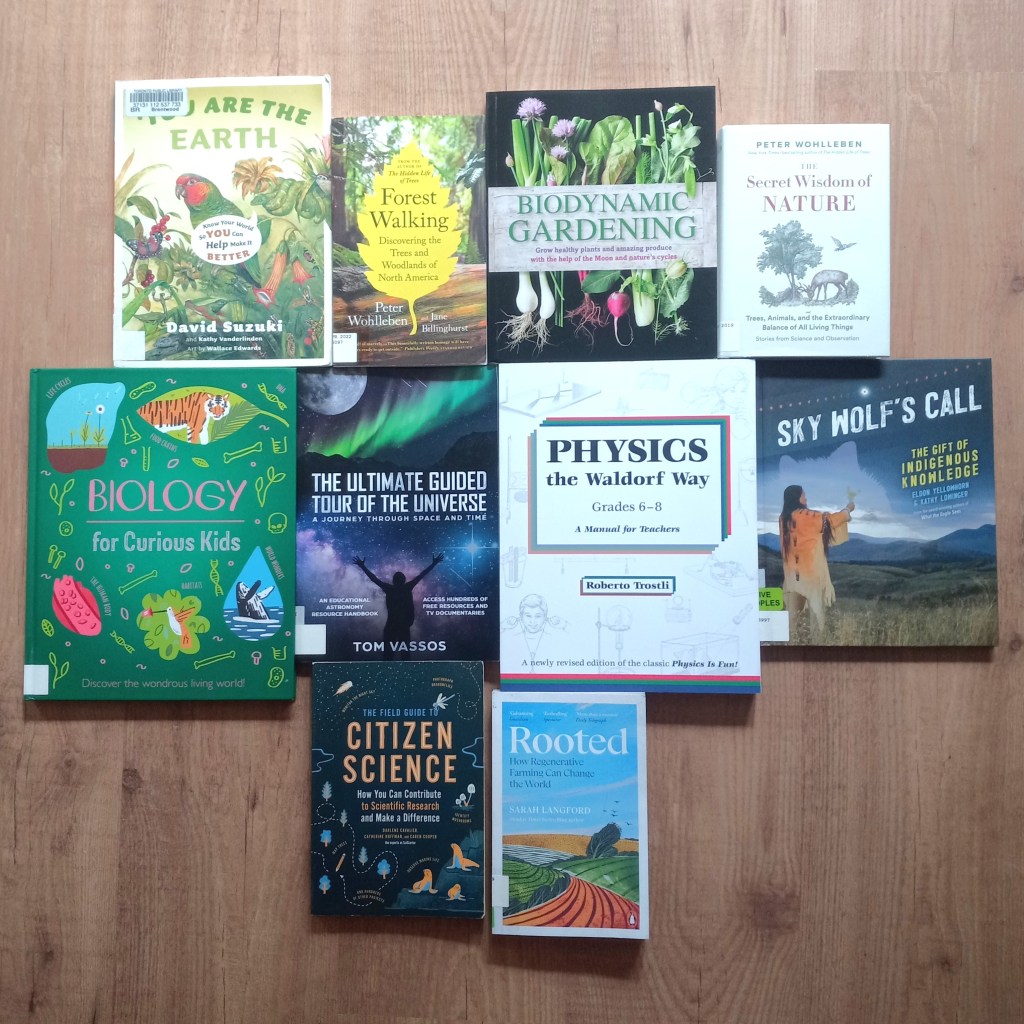
Science is not my forte, but Steiner inspired education is, so when I find a good resource that isn’t “waldorf” I simply sprinkle some #steinerdust to make it suit our needs! Once you understand the whys behind , it is easy to take anything and make it your own. If you would like to learn more about how science is taught from a Steiner perspective, reading Tasks and Content and Rudolf Steiner’s Curriculum for Steiner-Waldorf schools are a great start. There are also many resources available on waldorflibrary.org.
Another fabulous science resource are the units created by Canadian homeschooler Monique Willms over at Wonder House Creative. You can find her website HERE. We have really enjoyed her Intro to Neuroscience and Intro to Genetics and are looking forward to diving into her Microbiology units in the spring.
I think the thing that stands out most in our science lessons isn’t what the children have discovered but what I myself have discovered! I did not enjoy science in any stage of my education, and really none of the concepts stuck. Being able to walk through so many of the concepts with my children, and really understanding the phenomenon behind them, has created in me a love of science! And it is so wonderful to see my children fully embracing it as well.
I hope this post has given you a glimpse into what science education can be when we change our viewpoint. Essentially what it comes down to, stated in the simplest of ways, is we as teachers need to talk much less, observe more and create opportunities for unhindered observation and interaction for our children.
Until next time,
Marina
Discover more from Growing Together in Freedom
Subscribe to get the latest posts sent to your email.

