
We are all storytellers.
It is something that I often need to remind parents of young children and those in the lower grades. We don’t need to meticulously memorize stories written by other adults. We can gather the impulse of these stories in our hearts and retell the story in a way we know will capture our children. Or we can simply make up our own.
We all used to be storytellers. In our hearts lies the child who spent hours and hours creating and telling stories about the world around them. That child is still there, their spirit snuffed out by years and years of prescriptive writing tasks and distractions from play towards a more academic focus.
Storytelling and verse live strong in the heart of a child. They are automatically drawn to simple tales of life because story helps them to understand the world. Stories that are developmentally appropriate for young children are predictable and hold archetypal images, actions and characteristics of the human being. In other words, they paint a picture of the world that children are growing into and give them a way to practice for the future. For the young child, stories we bring paint images of a world filled with goodness. For the growing child, we bring stories that show them there is goodness in the world.
We can all tell stories. That child is still within us. It just needs nurturing.

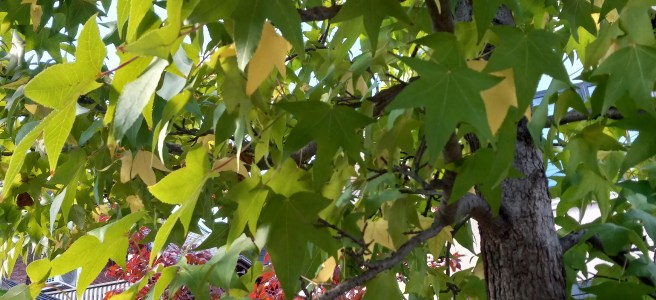
When out on a walk this week I came across this sweet little leaf. Can’t you just see the gnome within its shape? I instantly envisioned a little acrobat gnome and came up with this little tale. Since my children have grown my own storytelling muscles have not been in use as they were before, but it is something that my heart has been calling me to the last few months. So, I’m sharing the original imagining of the story that came from this leaf, without editing it or polishing up the rough edges to show that every story starts somewhere. I hope you enjoy it.
In a time not so long ago, beside a very large forest, there was a meadow. A family, looking for a new place to call home came across this meadow and decided it would be a wonderful place to call home. Soon enough, more people came across this same meadow and a village was formed. They used the trees around the forest edge to build their home, keeping the seeds so they could replant more trees along the forest edge. The forest was so large that no end could be seen in either direction. All the adult villagers told the children they must not go into the wood because it was very dark and easy to lose your way. So the children play beside the forest edge and were safe and content.
Inside the forest were the forest gnomes, busily tending to the trees, ferns, bracken and mushrooms. They were so excited to have a village form beside their home, but when they heard the villagers warning to the children, they became quite sad, because they didn’t feel their forest was dark at all! And what the villagers didn’t know is that on the other side of the forest was a pond surrounded by cranberry vines. Season after season, the villagers stayed outside the forest, never venturing further than a few feet in to collect wild berries from bushes and nuts that fell from the trees.
So the gnomes decided that they would welcome the villagers into their forest by planting two rows of trees right through the middle of the forest. All spring and summer they tended the trees and the trees grew and grew and grew. And then, as the days grew shorter, the gnomes disguised as yellow leaves, jumped upon the branches, and one by one slowly tumbled to the ground, creating the most beautiful golden path just the colour of the sun.
The children, playing beside the forest saw this golden path and called their families to come and see. Slowly, the families followed the path in through the forest, while the gnomes quietly giggled with pleasure that their village friends were coming into their home. The path led all the way through the forest to the pond surrounded by cranberries.
The families were in awe of the splendor of the harvest and each filled their pockets, making sure to leave most of the cranberries for the forest animals and birds. That winter, every family shared their findings with the gnomes, leaving scones and loaves on the forest edge for the gnomes to enjoy.
And each year, as the days get shorter, the gnomes put on their cloaks of yellow and create the magical path for the villagers through the forest.
So where do we start when reconnecting with those storytelling muscles?
Start with what is around you. Start with nature.
It is the most easily relatable subject around. We all have experiences with nature and those experiences can shape an endless number of tales. Nature gives us unlimited access to main characters and settings and adventure, no gnomes needed! I reach to gnomes and other elementals in my story telling because many of my experiences in nature connect with children, as my background is in early childhood education. But your tales will bring you different characters and a different feel dependent on your own personal experiences, imagination and audience.
In “How To Tell Stories To Children” Silke Rose West and Joseph Sarosy break storytelling down into three parts: Take something ordinary, tell a story about it, create something extraordinary. It could also be described as a loop of taking a reality, creating an imagination about it, which then creates a new reality. The authors go on to state that the beginning storyteller will often start with whimsy, and then work their way up to seeing the above loop in all sorts of situations. Taking that ordinary object helps to bridge reality and imagination and is a great way to start.
Will you try your hand at storytelling? I’d love to hear from you if you do!
Until next time,
Marina
Discover more from Growing Together in Freedom
Subscribe to get the latest posts sent to your email.

