I’m so please to have Melanie here with us today at Growing Together in Freedom! She is a dear friend and colleague, with so much wisdom to share. Melanie is a wife and homeschooling mother of two young children with a background in Early Childhood Education and many years experience working in Waldorf daycares, kindergartens and parent-child programs. Melanie is passionate about empowering families to enrich their own family culture by re- connecting with the rhythms of life and the art of homemaking. I hope you enjoy her composition on the transition from summer to autumn.
Have you noticed the changes? Leaves turning, cooler nights, birds migrating, the fruits of the garden ripening, or maybe thunder and wind storms?
There is a shift towards Autumn. In our household this means a large transition from our summer rhythm to our autumn rhythm. Transitions can be tricky for everyone, especially the children. How can we support the children and ourselves during transitions? How do I keep a healthy rhythm that meets the needs of the changes in the season, the harvest, the preparation for colder days? Children thrive in being connected with the rhythms of life, with repetition. This is where song and verse, story and time in nature can carry us along.
Susan Weber, Nancy Macalaster and Jane Swain reaffirm this in their book, Singing and Speaking the Child into Life
“ A Consideration of Transitions.
Rhythm is central to our lives. We live within the planetary rhythms, the seasonal rhythms, the daily rhythm, and the rhythms of our physical bodies. Rhythm holds and sustains us. Let us consider our breathing, with in-breath and out-breath, moving us between periphery and point and back again from point to periphery. And there is also the rhythm of our digestive system, We ingest, digest, and assimilate, a process that sustains our physical well-being. If we closely observe these rhythmic processes, we notice that in between the taking in and the letting go there is a pause, a transitional ‘hold button’ that serves as a bridge. Transitions hold the space between point and periphery.
Transitional space allows for the pause, the shift that we need in order to gather the forces to move forward. The pause is an opportunity and a calling forth; it is the space into which the higher ego can come. Children thrive on predictability, which allows for a sense that all is well, that they can trust that the world is safe. Transitional moments offer us the opportunity to guide our children with predictability and security from one activity to another in a day filled with rhythm. In Nancy Macalaster’s parent-and-infant/toddler groups, song is used to “hold” the transitional space and gently guide both parent and child to what comes next. We all do better when we know what is coming, how we are going to get there, and how we are going to engage with the new. In this way, music serves as a behavioral cue.
When children are fully engaged in the experience of an activity important to them, it is necessary to gently lead them to what we as adults deem to be the next, sometimes very necessary, activity. Holding the transitional “pause” or “bridge” is critical for the child’s emotional and social wellbeing. When our activity is disrupted before we are ready, we all experience a sense of disequilibrium.”
They go on to say: “What we need to remember is the importance of predictability. So singing the same song, doing the same gesture game, or playing the same touching game is critical. Repetition holds the child in a cradling gesture of safety: ‘I hear that song or we play that game and I know what comes next and I feel safe and held.”
I was struck as to how this also applies to the greater rhythm of the year, the rhythms of the seasons.
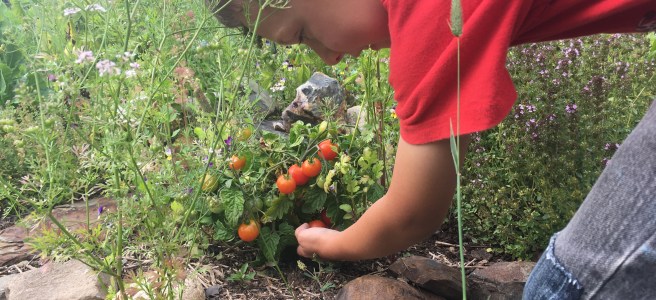
We can support the children as we transition from one season to the next with song and verse. We can elevate the daily by creating our own seasonal family rituals. This could be as simple as changing the summer clothing out for warmer autumn clothing or creating a harvest mobile from nature treasures collected on outings. In our family we change the meal blessing from season to season, we search for signs that Lady Autumn is on her way and it is harvest time. Our afternoon time outside is spent harvesting the fruits of the summer.
The biggest change in our rhythm is that we stay inside after breakfast starting in autumn. My husband and I decide when to switch to this rhythm which is usually mid August. This time inside is used for preserving the harvest. The children play freely or help with the homemaking tasks. Once my task is done we head outside carried along by this song (I find this song especially helps when having to put on more layers of clothing):
Come said the wind to the leaves one day
Come over the meadow with me and play
Put on your dresses of red and gold
Summer has gone and the days grow cold.
So cold, so cold.
Summer has gone and the days grow cold.
When we bring song and verse and small rituals into our days we elevate the ordinary. We bring joy and wonder to our days.
Harvest Meal Blessing
For sun and rain
For grass and grain
For all who toil,
on sea and soil.
We give our thanks
and love to you.
Blessings on our meal.
| For sun and rain | Hands come together in a circle above head turn palms forwards and wiggle fingers while lowering hands almost to table |
| For grass and grain | move hands up in gesture of growing plants |
| For all who toil, pm sea and soil | hands lower to horizontal and move in a waving motion Hands and arms become still |
| We give our thanks | Lift arms and cross hands over heart |
| and love to you. | Palms up and open arms |
| Blessings on our meal | Hold hands as this is said |
Wonder:
On our small growing homestead we experience the wonder of the season in our gardens, forests and yard. We take time to pause, to notice what is happening, to share the wonder and awe of the world with each other. We gather the seasons bounty with gratitude. When going on our walks, we bring baskets and containers to gather berries, mushrooms, and plants along the way. This time of year is filled with so much exploration and joy as we discover nature’s treasures!
As we were walking through the woods the other day my oldest noticed a mushroom hanging in a Red Osier Dogwood branch and delighted in the fact that the Squirrels are drying mushrooms for winter’s cold. Which brought on a song that the children have enjoyed over the years:
Squirrel Nutkin
Squirrel Nutkin has a coat of brown,
Quite the loveliest in woodland town;
Two bright eyes look round to see
Where the sweetest nuts may be.
Squirrel Nutkin in his coat of brown
Scampers up the trees and down;
Dashing here and swinging there
Leaping lightly through the air.
All the live long day he plays
In the leafy woodland ways
But at night when squirrels rest
In their cozy treetop nest.
Bushy tail curled round his head,
Mister squirrel goes off to bed.
A lovely link to this tune:
This song lends itself beautifully to be told as a lap puppet play. The children also delight in acting this out once they have become familiar with the story. Couches and chairs are used as trees and nests, tree cones or rocks as “nuts” that are found and “stored ” add to the fun.
For children joyful repetition of song and verse meet them where they are at. I have used the same songs, stories and verses year after year. New ones have been added as needed. I can see that the children are “digesting” life when the songs, stories and experiences show up in their play. Squirrel play seems to return every year in the Autumn and over the years my husband and I have often jarred a toe against a stored “nut” when putting on our shoes.
Celebration
One way that we celebrate the season is a Harvest Potluck get together, where everyone brings something from their harvest. There is anticipation of the event coming up as we decide what to make with what we have harvested this year. Then we make something to bring to the gathering.
With this seasonal transition a few things that you could consider are:
Ponderables:
- How does our daily rhythm change at this time of year?
- How do you or can you celebrate this seasonal transition?
- What homemaking tasks are seasonal that need to be done? How can you incorporate this in a rhythmical way?
- What transitional “pause” or “bridge” can you incorporate into your day to help carry every one along and add predictability?
- Choose a song or verse to help carry you through the season.
- Where do I find joy and wonder in this seasonal transition?
- How can I bring nature inside in a way that celebrates the season?
- Create one new seasonal family ritual to begin this year.
Warmly,
Melanie
Discover more from Growing Together in Freedom
Subscribe to get the latest posts sent to your email.

