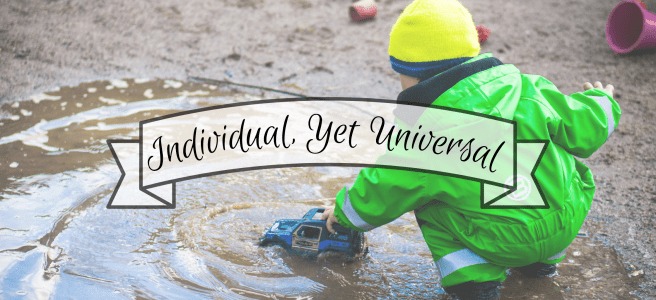
“The young child is both individual and universal from the very beginning.”
Cynthia Aldinger
Childhood is a unique time in the greater picture of human development. It is a time of total openness to the outside world. A time when magic lives around every corner and the world and all its seemingly mundane (to us adults) parts inspire awe in the eyes of a child.
Modern society has chipped away at this time and made it phase of preparation for adulthood, emphasizing the creation of children that “fall in line” over allowing the developing child to become their true selves. Supporting children in becoming their true selves does not equate hands off parenting or caregiving. On the contrary, it requires adults to be deeply involved in creating a responsive relationship, home and environment that allows children to be children.
As parents and caregivers, we have the honour of stepping up to protect these years. We can hold the years with reverence and support the child’s unfolding with trust and compassion.
Cynthia Aldinger, author and creator of The LifeWays model of care for children, has quickly become one of my favourite champions of childhood. She frequently writes and speaks on the importance of the early years, and focuses on specific principles and practices that center around nurturing a relationship between the adult and child as well as nurturing the relationship the child has with the world around them. Based on Rudolf Steiner’s indications for human development, it takes into account the entire child, head, heart and hands, so that the child is given the space to flourish while coming into their own being.
When we see a child through a lens of universality, it gives us a road map to consider. It helps us to see phases and stages, and points to a direction of where we are going. It reminds us that we all walk a similar path and that we share in the world around us.
When we see a child through the lens of individuality, we see the child within these phases and stages and how they are walking through them at their own pace, with their own will. In individuality we toss aside our own pre-conceived notions and judgements and connect with the child in front of us wholly and honestly so we can see them clearly. We see how they are taking the world in and making it their own, and how they are giving to the world a message about what they need to unfold their own becoming.
If you would like to put this concept into practice, when you catch yourself comparing one child to another child, or when you find yourself worrying or anxious about a particular area of development, stop and take a breath. Look into the universality of the phase the child is currently walking through and see where they fit into the bigger picture. Now, with that bigger picture in mind, look at the child again through the eyes of honesty, without fear or judgement clouding our connection. Where is the child within the bigger picture? What message is being sent? What is the child trying to tell us? From there, you can begin to create a picture of support that will continue to guide them through the phase in a way that meets there needs right now.
Seeing our children in this way not only helps us to guide them with honesty, but the children FEEL this shift and begin to show their true needs. It allows them to become.
Until next time,
Marina
Discover more from Growing Together in Freedom
Subscribe to get the latest posts sent to your email.

