
Painting: Steiner style.
It’s a mountain many first time Steiner inspired homeschoolers think they are going to die on.
If that sounds a bit dramatic, it might be the lingering memories of feeling like I didn’t know what the heck I was doing when I first started. There seemed to be so many rules, so many ways to do it wrong and so much out there in the internets that directly contradicted what Steiner suggested! That’s actually where I went wrong. I should have just stuck to learning from Steiner’s lectures and using them as my guide. Alas, I googled and, as I have learned as I’ve grown older (and hopefully a bit wiser), things are rarely clearer after a google!
Painting with children need NOT be a complicated. I’m in the process of preparing for my Grade One Overview workshop, and as I dig through all our paintings from my children’s grade one years, I’m reminded how simple it all was, and how I could have released all the stress and worry I carried had I trusted my instinct.

One of the most persistent instructions “out there” about starting painting with children in grade one is that they should only be exposed to one colour at a time. If you read through Steiner’s educational lectures, he actually never said to use just one colour with children who are starting off. The first exercise he recommended was actually to contrast blue and yellow, and then yellow and green so the children can begin to build a relationship with the way colours interact with each other, the individual gestures and mood of each colour. We don’t need to verbalize these things for them, although Steiner did suggest that we point them out if necessary. Most children will come to have an inner experience where they feel these things on their own through experience and exposure.
You need not hesitate quite early on to take out a box of paints and set a glass of water beside it (indeed, it is a good idea to conduct such lessons quite soon with the children). After you have pinned white paper to the blackboard with drawing tacks, you take up a brush, dip it in the water and then into the paint, and make a small yellow patch on the white surface. When you have finished, you let each child come to the blackboard and make a similar small patch. Each patch must be separate from the others so that in the end you have several yellow patches. Then you dip your brush into the blue paint and put blue next to your yellow patch. And you let the children come up and put on the blue in the same way. When about half of them have done this, you say: ‘Now we shall do something else; I am going to dip my brush in the green paint and put green next to the other yellow patches.’ Avoiding as well as you can making them jealous of one another, you let the remaining children put on the green in the same way. All this will take time, and the children will digest it well. It is indeed essential to proceed very slowly, taking only a very few small steps in the lesson. “
Steiner, August 25, 1919
In Spiritual Grounds of Education:
…In the painting lesson, children are not taught to draw or make patterns. They learn to work freely and spontaneously with color itself. Therefore, it is very important that children have the right experience of color. The children learn nothing if you allow them to dip their brushes in the little blocks of color in an ordinary paint kit or use a palette when they paint. Children need to learn how to live with color. They should not paint from a palette or blocks of color but from a jar or mug containing the color dissolved in water. Then they get a feeling of how one color goes with another and feel the harmony of colors through inner experience.
Steiner, August 23, 1922
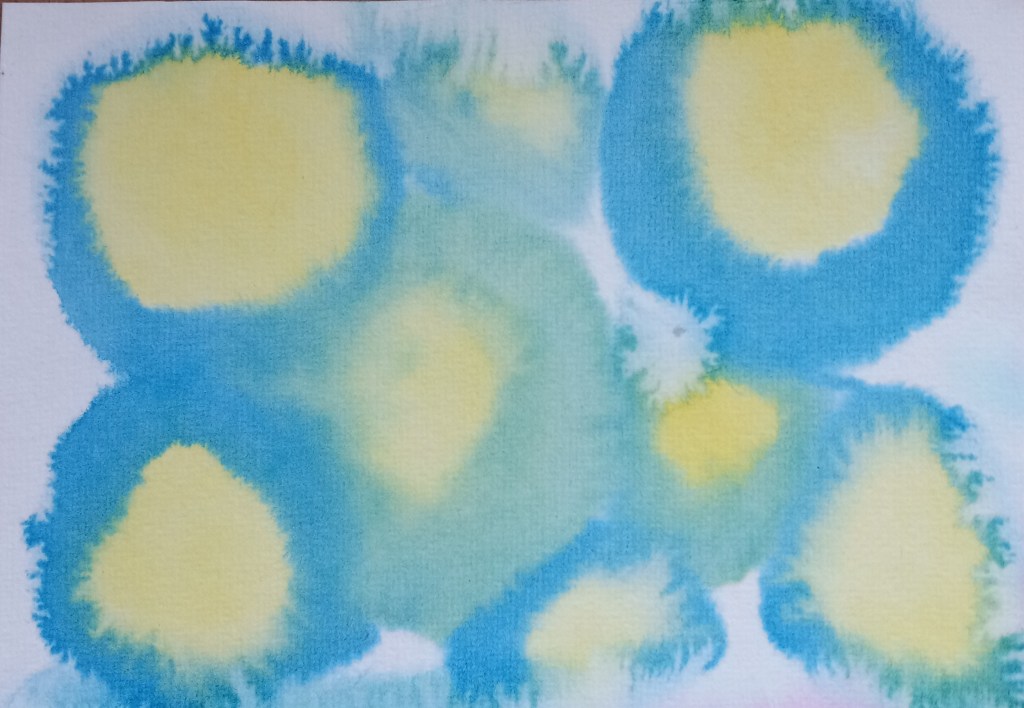
This is 100% not to say that you can’t work with one colour at a time, because I do believe that we can actually become pedantic about being anti-dogmatic as well!! BUT, if spending painting classes using just one colour is something you know won’t speak to your children, then don’t feel like it is something that you have to do because everyone else does.
So where do you start? You start at the very beginning (as Maria from sound of music so wisely sings)
Wet on wet painting has a process, and the children should be included in the entire process, from start to end, so they understand all the pieces to painting. Including your children in the set up and clean up is important. We usually did our painting in the afternoon after some outdoor time, so in preparation would set our paper to soak before we went outdoors (This is actually still our routine, even though my children are teens! If we are going to be painting together, these steps are automatic!). When we came back in, each child would set their painting board, paints, paint brush, cloth, sponge and jar of water on the table and I would bring the tray of paper from the kitchen. We’d all wet our boards and gently smooth the paper onto our page with the sponges. Then we’d light a candle and start our painting experience.
The reverse would happen after we were done. The children were involved in every step of the process. Over time, this helped curb the spills and accidents that invariably happen when painting with children. But to start? The whole process of setting up and taking down seem to actually take longer than the painting experience itself! I was left wondering if this whole wet on wet experience really worth all the effort?!?
Steiner quotes have habit of jumping off the page just when I need them most, and one day while I was searching for information on handwork, I came across this paragraph in The Spiritual Ground of Education:
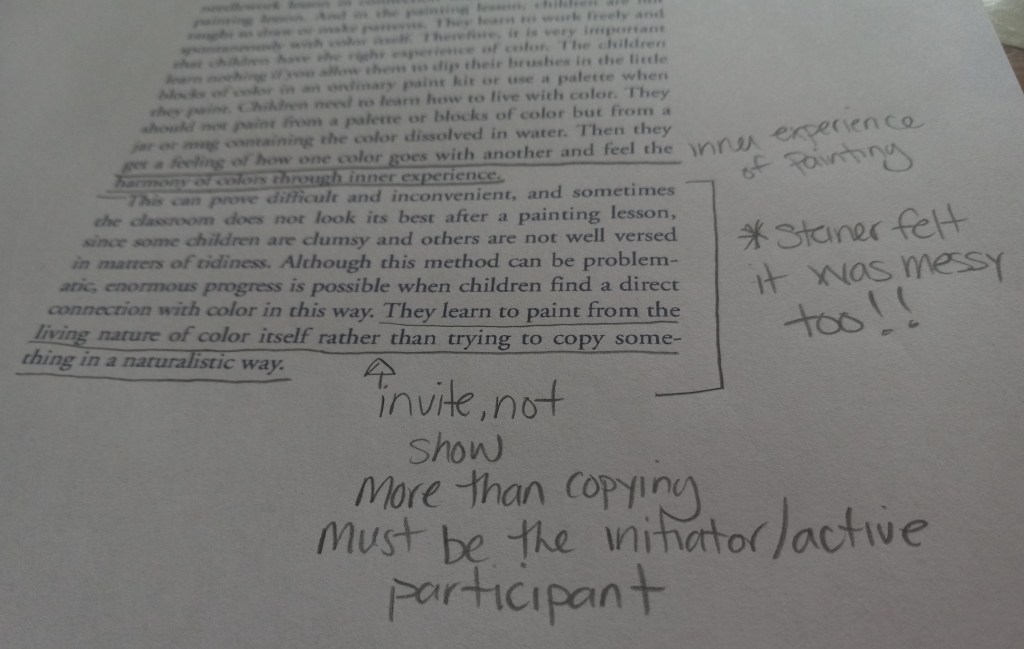
This [wet on wet painting] can prove difficult and inconvenient, and sometimes the classroom does not look its best after a painting lesson, since some children are clumsy and others are not well versed in matters of tidiness. Although this method can be problematic, enormous progress is possible when children find a direct connection with color in this way. They learn to paint from the living nature of color itself rather than trying to copy something in a naturalistic way.”
It was exactly what I needed to read. Yes, this process was messy and fussy and required so much from myself. Yes, it would have been easier to just use a palette and teach them to paint in a conventional way. But I chose to educate my children differently because I didn’t want conventional, and sometimes that means processes that aren’t as easy.
And honestly, after time, it was smooth sailing.
So what did we DO for grade one painting? Well, quite simply, we played with colour! We drew dots and arcs and spread one colour on one side of the page and one colour on the other. We watched how they blended and mixed and carried and pushed each other. We discovered just how “bossy” yellow can be with its constant spreading and taking over the visual space, and how blue, oddly enough, feels really good on the bottom of the page. And how red pops with every colour except yellow, because yellow will always win. After all, it IS the colour of sun and gold and as my daughter once said, yellow is life.
Our painting times were so informal. Remember, I didn’t know what I was doing! I didn’t have access to any of the waldorf school painting books so I went with my intuition and the snippets I gleaned from reading Steiner’s lectures. I think, over all, we experienced what we were meant to experience in first grade, and that was to build a relationship with colour. These were not lessons. I was not teaching. Steiner stressed many times in his lectures that it was SO important for these impressions to come from the children, so we experienced together and sometimes I would ask a question or two, most often I’d point something out and see what the children’s thoughts were. But these were definitely NOT lessons. And I think that is what made these experiences work.
I hope this helps to release some of the stress painting with children for grade one might carry. My best piece of advice? Experience it with your children and leave the “teaching cap” at the door.
Warmly,
Marina
Discover more from Growing Together in Freedom
Subscribe to get the latest posts sent to your email.

